Sunday, August 29, 2010

Saturday 28 August: The Diocese of Matlosane

Now, let’s get the cricket out of the way first of all. The last news I had of England’s first innings in the final test against Pakistan came at lunchtime yesterday, when they were 92-5. It transpires that they lost two further quick wickets after lunch and were at one stage 102-7. Then Stuart Broad and Jonathan Trott apparently put together the highest 8th wicket stand in the history of the game, so that England ended on a barely credible 446 all out. Pakistan were then bowled out for 74 in their first innings. Talk about a turn around.

Anyway… where to start… Bishop Stephen gave up the whole day to take me on a whistle stop tour of his Diocese. It’s vast. We covered over 400 kms in 8 hours, with frequent stops, visiting 6 churches in only 2 parishes of the 20 that make up the Diocese. Admittedly, there is a concentration of parishes in the more urban (township) parts of the Diocese. But all the same it makes for some odd comparisons with the Diocese of Lichfield, which (though it is only one fifth as extensive in area) has over 400 parishes. Bishop Stephen can call on the assistance of only 36 clergy, many of them ‘self-supporting’ (ie, volunteers). Bishop Jonathan in Lichfield oversees about 500 clergy, more than half of whom are stipendiary. Yikes. The distances that some of these self-supporting priests have to travel (outside the hours they give to their paid work) in order to reach the most far-flung of their outstations is daunting. For about two hours of the day today, we were not on tarmac roads, but rutted tracks. It must be almost impossible for these volunteer priests to develop good pastoral relationships with their most isolated congregations, let alone with the neighbourhoods these serve.

From Klerksdorp, we drove north and west. The drive gave us plenty of time to talk. Bishop Stephen is an excellent conversationalist – not afraid of silence, but quick with helpful observations and a good listener. He pointed out to me one of the great differences between driving in England and driving in South Africa: on the whole, in England, the combination of rolling countryside and tall hedges/fences/ dry-stone walls limits the vista; in South Africa the roadsides are unobstructed and the flat plains means that you can usually see for miles. He also pointed out that whereas in England, the driver who weaves to and fro may be under the influence of alcohol, whereas the one simply follows the line of the road is probably sober in South Africa, the driver who weaves his way down the road is soberly navigating the potholes, whereas the driver who keeps to a straightline is invariably drunk.

We visited a number of towns (Ottosdat, Delareyville, Sannieshof, Wolmaransstad), their townships and outlying villages. Three things struck me: the first was that the townships are not indicated on the road signs, which always show only the names of the towns themselves. Almost invariably, town names are Afrikaans and township names are African – so that it’s hard to avoid the impression that the townships are being deliberately rendered invisible. It’s telling that the map I’m using has jogged my memory about the names of the towns, but is giving me no clues about the names of the townships. The second was that communinities are not simply ‘black’ or ‘white’: even so-called ‘coloured’ people tend to live in clearly demarcated neighbourhoods. One of the challenges faced by Bishop Stephen is how far to work with the grain of this continued segregation. Should he appoint a white pastor to an overwhelmingly white congregation, for instance? And the third thing that struck me was the prominence of death. We passed three funerals in the course of the day, maybe four. We also passed an astonishing number of funeral parlours – one of which refered to itself as a leader in the funeral industry. The funeral industry… there’s a thought. It is, of course, a terrible indication of the seriousness of the HIV/AIDS epidemic.

There was disappointment for Bishop Steve at the first place we visited. One of his initiatives has been to promote, on church grounds, the cultivation of vegetable plots. He had been enthusing to me about the project in the car: it encourages the poorest and most deprived communities to eat healthily and cheaply; it allows church people to give the produce away in their neighbourhoods, expressing love of neighbour in the process; and any excess can be sold off to produce a modest but much needed income for the parishioners. He was deliberately taking me to see one of the places where the project had, the last time he visited, seemed to be flourishing. But when we got to the place, we found the garden neglected. He pulled a carrot from the ground: the crop had grown but had not even been harvested. I could sense his distress. ‘I’ve brought my horse to the river’, he said.

He was more encouraged later in the day when we visited the community in which he himself had grown up. He pointed out to me the primary and secondary schools where he had studied, and the church where he’d worshipped as a boy, and where, as a member of the youth fellowship, he’d helped to build a vestry onto the side of the church building, which still stands. The garden there was obviously still being tended carefully, and gave grounds for hope. In one place we visited, we found a team of church members busily polishing the stone floor by hand in readiness for Sunday worship. They do it every week. In another place, the church was a simple shack. The Diocese owns the plot, but cannot at present afford to build a more permanent structure. The Cathedral, through it’s Traidcraft stall at congregational refreshments after the Sung Eucharist on Sundays, has raised enough money to have charged me with passing £1000 to Bishop Steve. I plan to talk further with our own Diocesan World Mission Officer, but one option broached by Steve was that we might use at least some of this money to help start a building fund.

We got back at 6-ish (5pm in the UK) in time to catch the Premier League football scores. I’m planning on an early night: we leave the house tomorrow at 7am, as I’ve been given the wonderful opportunity to preach and preside in the Cathedral of the Resurrection at Ikageng. The service starts at 8-ish, I’m told, and will end at 11-ish, and the congregation will consist of 300-500 people. It sounds great!

Friday 27 August: Transition Day

Today began with the conclusion of the Tenth International Congress on Calvin and ended with my arrival in the Diocese of Matlosane. It began, for me, in Bloemfontein and ended in Klerksdorp. So it saw the end of the first leg of my trip to South Africa and the beginning of the second.

The Calvin Congress ended at lunchtime. It had been a packed conference schedule and the days have sped past. Inevitably, the last hours had a slightly ‘de-mob’ feel to them. Some participants had to leave early to catch planes; and the rest of us were beginning to look ahead. But the final morning was not without highlights. One of the two presentations was on the subject of ‘Reconciliation in Calvin’s Sermons’ – given, interestingly enough, by a scholar from South Korea – so that there was again a huge political subtext). The lecture included this gem from Calvin about the care of the poor: ‘Our Lord requires of us that we should pay him his tribute, that is to say, the homage money that we owe him in acknowledgement that the things which we possess come from him, and from his sheer liberality. He does not send us either bailiffs or iron-fisted men, but the poor, and that ought to suffice us, for they are his true receivers’. I like that.

The Congress ended with some announcements about future plans (and the intriguing possibility – and it’s no more than that at present), that the 11th Congress in 2014 might be in India…). After that it took on the feel of the end of a Youth Camp – people swapping contact details and making almost tearful good-byes. Friendship are made and renewed at these events, and I’m especially glad at the chance I’ve had to meet or meet again some lovely people – among others from the Netherlands, Germany and Switzerland, the USA and of course South Africa.

I had a three hour interval between the end of the Congress and my departure for the airport, some of which I spent lying out in the sunshine, soaking up some rays. It was only the second opportunity I’d had to do that all week. For me, to sit out in the sunshine, feeling the warmth on my face, is bliss – and an intimation of heaven. The gloss was slightly taken off the experience, however, when I got online and discovered that England had slumped to 47 for 5 in the first innings of the final test against Pakistan. 92-5 at lunch was barely a recovery worth celebrating.

The flight from Bloemfontein back to Johannesburg was straightforward. Although it was slightly delayed, we made up the time in the air and arrived on schedule. Then a minor miracle: my bag was first off the luggage carousel. That never happens! I’d no sooner texted Bishop Steve, the bishop of our partner diocese of Matlosane, to say I was in baggage reclaim, than I was walking out into the airport concourse to meet him.

Bishop Stephen had kindly driven two hours from Klerksdorp, with Mekla (he’s the Rector – and Dean-designate of the Cathedral in Ikageng), to collect me. I first met Bishop Stephen at a conference I helped to organise for all our partner-Dioceses in 2008: CrossTalk. It’s lovely to see him again. He’s a wonderful example of Christian leadership: shouldering heavy burdens with humility and a ready and infectious laugh.

We drove first to Potchefstroom (which is where Mika lives, and where Ikageng Cathedral is). As we drove, we talked about the terrible public sector strikes which are paralysing some spheres of life here at present. The teachers are on strike, so children are not at school. And most horribly, hospital workers are on strike as a result of which some very old people and some very tiny babies have died. There is no sign of an imminent end to the chaos, after 12 days. It’s just one indication that the honeymoon is over for the new South Africa, which remains in some ways a troubled and divided place. To the outsider, its amazing that the country has come so far in the last 20 years without civil war… but much remains to be done.

Bishop Stephen's wife Brenda met up with us in Potchefstroom. She and he are both studying for Masters’ degrees at the university there – in their ‘spare’ time. We ate at a restaurant on the campus: the clientele was very white (the only black people I could see were my hosts) and very young.

Then Bishop Stephen drove Mika home, and I travelled the remainder of the journey with Brenda, and we all met up at their home in Klerksdorp, where we arrived soon after 10pm. Tomorrow will be a full working day: Bishop Stephen is going to take me to three churches in the Diocese, to see something of the challenges the church here is facing.

Friday, August 27, 2010

Thursday 26 September: Starry, Starry Night

Wow – the best was pretty much saved to last. We were graced with an inspiring contribution to the conference in the morning, and with an awesome evening at the Observatory in the evening.

The lecture in the morning was without doubt one of the highlights of this Congress. The context, of course, made the topic (‘Calvin against slavery’) particularly loaded: for many years the Dutch Reformed Church in South Africa (a Calvinist church) was one of the mainstays of the apartheid regime, and provided theological justification for the oppression. Our lecturer left little doubt that Calvin himself regarded slavery as an appalling evil – why? Simply because all human beings are created in the image of God. ‘You and your fellow human being are the same’, he wrote. ‘Treat them like a beast and you become a beast yourself, because you renounce the image of God which is imprinted in us all’. It’s really for insights like this that I have grown to love Calvin’s theology and writings. Especially if you allow for the fact that he lived 500 years ago, these sentiments are extraordinarily adventurous and spring directly from his grasp of the nature of God as love and grace. ‘In some lands’, he says in one sermon, ‘such as the countries of the East, Greece and North Africa, this type of servitude still exists. However it is for the best that its usage be altogether abolished, as it has been among us’. Equally moving was the applause with which this paper was received, by a thoroughly international and multi-cultural audience, including of course black and white South Africans. Wonderful.

There were other good contributions to enjoy during the day, but many of us were reaching that point in the week where you just feel as if your brain is full to capacity. The periods of discussion after various presentations (including one in the late afternoon which I was privileged to chair) were getting shorter and less creative, and there was a general sense of tiredness around the place.

But we perked up at the Boyden Observatory, that’s for sure. It’s about a half hour’s drive out of Bloemfontein, which is far enough to leave behind the light pollution of the city. It’s also set high up on a hill, and we arrived in the late afternoon, in time to enjoy panoramic views over a river valley, bathed in a pink sunlight, with the plains apparently extending endlessly in the direction away from Bloemfontein. Within a short time we were blessed with a dramatic sunset, as we tucked into a picnic meal, with copious amounts of South African wine provided by our hosts. As you can imagine, the atmosphere became very relaxed indeed. Not that Calvin would have disapproved. One of my favourite of his sayings comes in his commentary on Psalm 104: ‘It is lawful to use wine not only in cases of necessity, but also in order to make us merry’. It was pretty merry, by the time we were called to order by a Professor from the University Physics Department, who gave us a lecture on the progress of the search, in which he is involved, to find planets in the universe whose conditions might most approximate to those on earth. He was humorous and judged the occasion well. He reminded us that our galaxy is a tiny part of a Local Group of galaxies, which is a small part of a Local Supergroup of galaxies, which is an infinitesimally small part of the universe. He quoted a famous astronomer (I didn’t catch the name) who said, ‘The universe is a big place… perhaps the biggest there is’. And then we were divided into three groups, and each group in turn was taken first for a brief ‘live’ introduction to the night-sky in the southern hemisphere, then to see the observatory’s 1.5m telescope (the third biggest on the continent) and then to look through a slightly smaller telescope at what appeared to the naked eye to be a star-less stretch of sky, but which proved to be filled with thousands of stars. The operator of the larger telescope described it as a digital camera which an unusual large lens on the front.

The professor used a lazer to point out the stars in the sky. I don’t ever remember seeing Mars or Saturn before. We saw the Southern Cross and its two out-lying pointer stars, as well as Alpha Centauri, the Scorpion, a red dwarf (I think!) and lots of other features (including our nearest star, which is still, I think…, four light years away). I’m afraid I’ve forgotten most of the specifics -- except that there was also an iridium flare from a satellite… and then, wonderfully, a meteor shot past as if scripted. We almost burst into applause, as if it was a firework display!

‘Awe-some’ is an overused word these days, but this really was.

That was yesterday. Today the congress has finished, and I’m about to head off for the airport, to fly to Johannesburg, and then (I hope by car) to our (I mean Lichfield’s) partner Diocese of Matlosane, where I should be by tonight. I’m not at all sure what the internet facilities will be like though, when I’m there… so there may not be further blog postings until Tuesday of next week. Silence in the next few days will just mean I’m out of web-reach. Probably just as well, given England's current cricket score (68-5; ugh).

Thursday, August 26, 2010

Wednesday 25 August: The Mountain Kingdom

Well. That was memorable. We’ve had an ‘excursion’ today, to the independent Kingdom of Lesotho – an experience not to be quickly forgotten.

We set out early this morning. We were on the road by 7.30. The journey took us past some still poorer townships than those we visited last Sunday morning… vast, sprawling (sorry, it’s the only adjective I can come up with at this time of night) expanses of corrugated iron dwellings, without either electricity or running water. Scary.

When we got to the border, it was like being back in the 1970s: we all had to get off our fleet of three coaches, file on foot through the SA emigration customs, across the border to queue again to get through the Lesotho immigration. Then it was back onto the buses.

On the Lesotho side of the border one of our number noticed that a roadside cafĂ© had ‘VR’ daubed on its wall. Victoria Regina. She’s the reason Lesotho was never subsumed, like other African kingdoms, into the republic of South Africa. At a certain point in the mid 19th Century, soon after the first (French) missionaries arrived in the area, the Afrikaaners appropriated parts of Chief Mushoeshoe’s territory. He appealed, successfully, to Queen Victoria for protection – and the British Crown then, as it were, underwrote Lesotho’s independence for the next one hundred years or more.

When I was working in the Diocese of Durham in the mid 1990s, the Diocese of Lesotho was our partner. So I was hearing about, and indeed praying for, this part of the world years ago. But this was my first visit. (It’s not strictly my first visit to South Africa in general though. I was briefly in Durban and Cape Town -- as a nine year old in 1970!) The journey took us across flat, dusty, grassy plains on the South African side of the border, and then at once up into the mountains which define this country. From time to time we passed the round, thatched mudstone houses that I associate more with Zulu settlements. Inevitably, the poverty in Lesotho eclipsed even the most severe we have encountered in South Africa. We were seeing it at the driest time of the year: everything looked brown or sandy or ochre. But apparenty, in another two months, when the rains have come, Lesotho is as verdant as England. I was struck when, at once point in the day, our Lesotho host gave us a traditional blessing: ‘Peace, Rain, Prosperity’. I felt a long way from home at that point… We’d say, ‘Peace, Sunshine, Prosperity’!

Our destination today was the headquarters of the Evangelical Church of Lesotho – which is the oldest church community in this country, founded by those French missionaries in 1833. The name of the place is the name given to it by those two intrepid pioneers. They called it ‘Morija’, after Mount Moriah, where Abraham met with God. It’s where the LEC now has its seminary, archives and printing press.

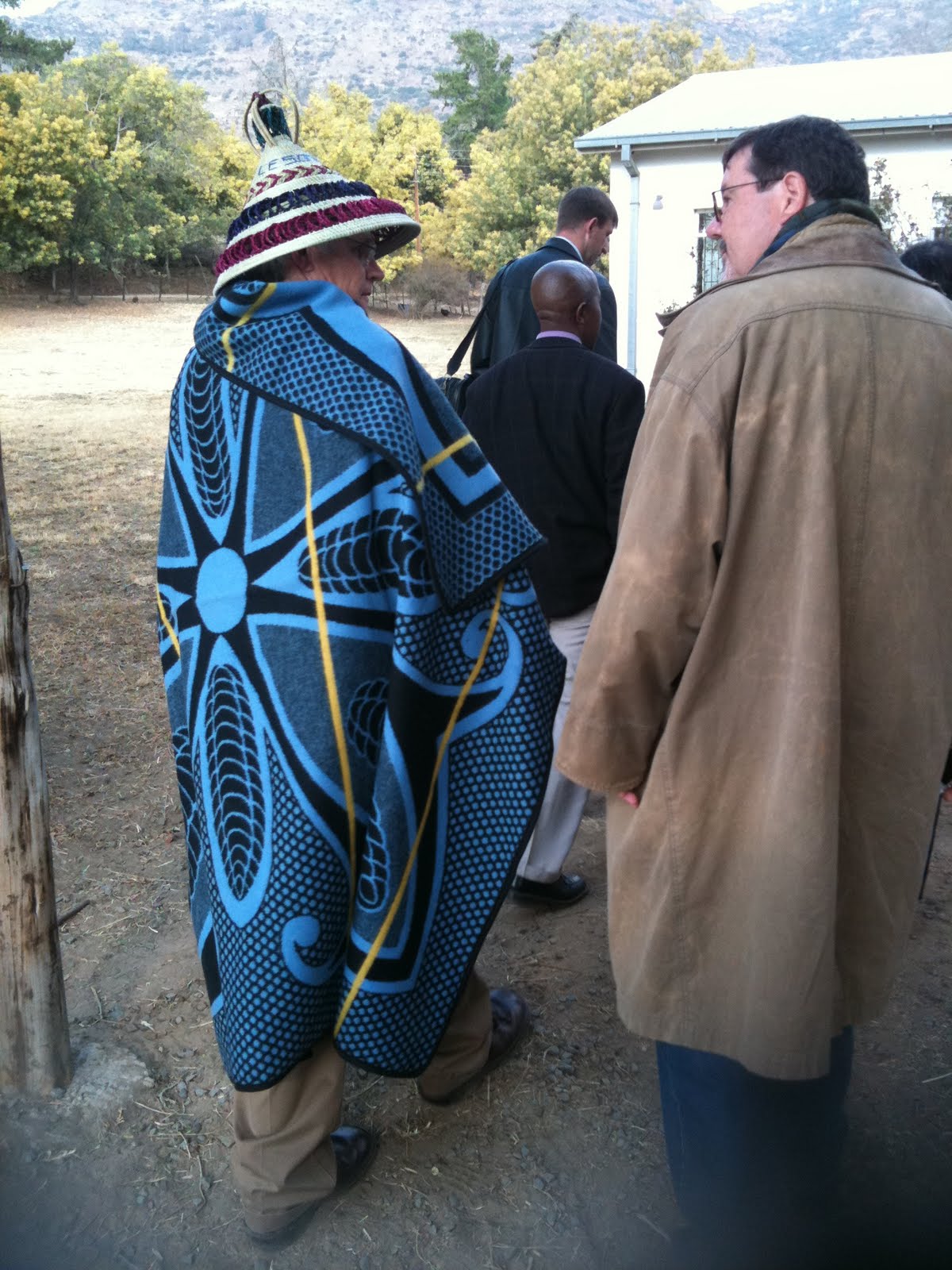
We’ve become used to a saying, when things at the Congress haven’t gone precisely to plan: TIA. This is Africa. It was TIA all day today. Mostly on account of the chaos at customs, we arrived at our destination an hour late. We were greeted with tea and cake, and then to a longer-than-expected presentation on the history of the LEC. Either side of this, however, were some unscheduled ‘extras’: an opening prayer which included some congregational singing by our hosts, an then extended introductions and welcomes, with several local dignitaries, including one local chief (without whose blessing we could not feel safe nor at home, according to cultural tradition), each invited ‘to say a few words’. By the time the first session began (an elegant study of what ‘Theology’ looked like in Calvin’s Geneva – in short: immensely practical and, unusually for that period, inclusive of lay people) we were running almost two hours behind schedule. It was a neat cameo of the culture clash between the westerners and the Africans. Many of us were twitchy about the departure from the schedule. It was clear our African friends were not in the least bit bothered. It was fun, though, to see two of our number officially presented with the conical hat and decorated blankets which constitute the principal items of national dress. We pressed on with a paper given by a scholar from Lesotho on Calvin’s influence on the preaching of the pioneer missionaries, and sat down to a late, late lunch at about 3pm. We were then given a swift tour of the community: the earliest church to be founded in the kingdom, the seminary, the archives and museum and so on.

We left at about 5.00pm for the capital city, Maseru. There had been hopes of some time to shop there for souvenirs – like the trademark blankets that local people wear to protect themselves from the cold. But the time had run out on us. So it was quickly into a hotel for yet another extravagant banquet of meat (pork, chicken, fish and lamb all at one meal!), rice and salad, with naughty deserts, before we set off to return to base, only to be required to go through an even more elaborate exercise at the border: we dismounted from our coaches to pass through customs at the Lesotho side, re-mounted to cross no-man’s land, dismounted again to pass through customs at the South Africa side, to re-mount for the rest of our journey. I was pleasantly surprised when we got back a few minutes before 10pm At one point in the day, I was sure it would be midnight.

If you’ll excuse the pun, the Mountain Kingdom will definitely be a congress highlight. We know we're in Africa now.

Tuesday, August 24, 2010

Tuesday 24 August: Unexpected Day!

Hmmm… despite a highly organised programme, today didn’t turn out for me at all the way I was expecting.

At breakfast time, a senior colleague of mine, with whom I’ve worked closely at previous congresses came over to explain that overnight he’d lost the sight in one eye. He had had a cataract operation in the Netherlands a few weeks ago, and although everything had been pronounced well, a complication had obviously developed. He needed now to find a doctor and perhaps to get some treatment. His difficulty was, that he was due to deliver a paper to the conference this afternoon – would I please cover for him by reading his text in his stead. ‘Actually, Franz, no’, just didn’t seem like an option. So of course I said it would be a privilege. Whereupon he handed over his text and some supplementary papers.

So I checked out the morning programme and decided that I would skip the first session in order to have a read through of his paper. Or two. The first session was, in any case, a rather dense looking theological study to be delivered in German. The second session looked more interesting – an account of ‘Calvin’s Catholicity’. But I figured 90 minutes of preparation would be enough.
Unfortunately, there had been some delay on the photocopying of the English translation of the first paper. So unknown to me, the first two sessions were switched around and while I was in a sideroom reading through Franz’s work, I was missing the session I had hoped to attend. Heigh ho.
In the event, for one thing I was waiting a bit anxiously for GCSE news from home (which came through by text and was fine!), and for another the preparation took a bit longer than I expected, and for another I was feeling a bit peeved at missing the ‘Catholicity’ paper, and for another the sun was shining outside… so the upshot was that I skipped the second session too and spent a relaxing hour in the gardens instead, soaking up some rays.

Then, after lunch, I read Franz’s paper. It was an odd experience, but I was glad to do it. He’s a fine scholar and he had put together a strong argument for the case he was making – but he’s a Dutchman whose English (while stacks better than my Dutch!) is a bit Germanic… so I was trying to ensure it was his voice that people were hearing, while tidying up the grammar and syntax at least a bit! In the event his doctor’s appointments went well in the morning, and he was not only able to be there (albeit with a huge patch over one eye), but was able to field questions after I’d delivered his talk. And he’s been reassured that the eye will right itself in a few days.

I did attend one of the afternoon sessions, but I’m afraid by 5.15 I’d had enough for the day. My brain was full. So, now into the swing of bunking off, I took myself off for a walk round the University Campus during the last session.

Now we’re back at the accommodation, as early as we’ve managed it so far (8.15pm local time). We’re all intending to have an early night, since we’re departing by coach tomorrow at 7.00am for the kingdom of Lesotho, for a day’s excursion. Should be great.

Except of course, that it may turn out as unexpectedly as today.

Monday 23 August: Long Day!

Ok. I have to admit that was more like work. But I did get to see the site crocodile.

Our coach from the accommodation to the conference venue left at 8.10am for opening worship at 8.30, leading directly into a first session. We had a coffee break of half an hour at 10.30, lunch at 1.00 (for an hour… but in my case involving a meeting ), and another coffee break of half an hour at 3.30… but we’ve only just got back to the Lodge now (admittedly after a formal dinner at a prestigous local restaurant) at 10.00pm oui time. We certainly know that the Congress has begun.

The first main session was an overview of what was an important year last year in the world of Calvin scholarship. 2009 was the 500th anniversary of Calvin’s birth, and all kinds of events (conferences, exhibitions etc) and publications (about twenty new biographies alone!) were arranged to mark the occasion. The speaker gave us a summary of what had happened, laced with humour and salted with some wise reflections on what it all might or might not amount to. It was good to hear her emphasise that, just like all the prominent figures in the Bible, Calvin should always be remembered warts and all – he was, after all, the most vigorous preacher of the grace of God, and was fully aware of his own weaknesses and shortcomings. Among anniversary conference venues in 2009, many were predictable: Geneva, Belfast, Pretoria, Dordrecht. But others were less so: St Petersburg, Seville – and Beirut, even! We laughed at the news that a piece of public sculpture (a bust, in fact) has even been erected to mark Calvin’s cutlural contribution in… Havana, Cuba; and at the news that the American Postal Service issued commemorative stamps last year, to acknowledge the legacy of Abraham Lincoln, Gary Cooper and Bob Hope… but not John Calvin.

There was a substantial paper on Calvin’s understanding of reconciliation (a loaded subject in this part of the world). The paper was given in German, and I’m afraid that in common with some others I was unduly distracted by the poverty of the English translation which had been prepared for those who did not wish to rely on their German. It was comical – some splendid typos like ‘tree positions’ instead of ‘three’ and ‘dump symbols’ instead of dumb; as well as some very clumsy, clunky English sentences: ‘Like this were to clarify, how itself that the holiness of the Christian Church in the life of reflecting their mutuality and were to do’. Even given the tortuous nature of theological German, it’s gobbledegook!

Not wishing to gloss over a very competent introduction to Calvin’s early formulations of a doctrine of the Lord’s Supper, a highlight of the day for me was a paper looking at Calvin’s whole work as standing in continuity with the medieval and patristic monastic tradition. It’s a counter intuitive idea, because Calvin had some trenchant criticisms to make of the monastic orders of his own day. But the speaker made a good case that Calvin was attempting to take the monastic life out of the monastery (or at least to plunder the monastic treasury) and make it accessible to ordinary Christian believers – he coined the nice phrase ‘the Monkhood of All Believers’. He pointed out Calvin’s commitment to Psalm singing by lectionary calendar (we had done some of that, lustily, in our opening worship, in the Genevan style), and to a daily pattern of prayer at set times (or at least set occasions, rather like the monastic office). He emphasised Calvin’s view that all Christians have a high vocation and, given the degree of accountability of citizens in Geneva to the authorities for their behaviour, posed the idea that Calvin functioned as a bit of a secular abbot. I found it thought provoking, I must say.

This evening we’ve enjoyed an official conference dinner, hosted by the Rector of the University (the Vice Chancellor). He is a remarkable man… Prof Jonathan Jansen. (He told us his father is Abraham, and his mother is Sarah and that all his brothers and sisters, like himself, have biblical forenames… except one, ‘and he’s the only decent one among us’.) He told us how he had abandoned a Christian faith as a teenager to join the struggle to end apartheid (because the church, classically, kept telling him not to engage in politics but to remember his ‘citizenship is in heaven’), only to find that the anger he developed became a liability to him in later years. ‘I’m ashamed to tell you this today’, he said, ‘but I came to hate white people’. But he subsequently came (through a journey that introduced him to Liberation Theology and Black Theology) to realise that he himself stood in need of forgiveness and of the presence of God in his life, that it was only in being forgiven that he found a capacity to forgive. It was an inspiring speech from a man with a touch of Mandela about him.

The only drawback was that the venue was c-c-c-c-cold. It’s the end of winter here. The climate is very predictable and all three days we’ve had clear blue skies, lots of sunshine and temperatures in the middle of the day in the early 20s. But in the early mornings and in the evenings and overnight, it is cold. It dips to freezing point in fact. And most of us had dressed for the conference day, not for the dinner – or had assumed that the dinner would be in a well-heated venue. But we were in an usual place out in the countryside outside Bloemfontein, in a wooden structure with thin walls. It was pretty, but not warm… and even the large open fire in the downstairs courtyard only thawed out our feet before we got on the coach to return to our lodging. My heating is on full blast tonight and I can gradually feel the blood in my feet unfreezing!

Oh, and the crocodile was a disappointment. He looks very sorry for himself, like any wild animal in captivity. He lies in his pool, which is heavily fenced in, and barely moves. Why should he? His food is tossed to him daily, and in any case, there’s nowhere to go. Must be a parable of something.

Monday, August 23, 2010

Sunday 22 August: Surprised by Joy...

With apologies to the author of the biography of C S Lewis by that name, today has been a day of joyful suprises.

I had been telling people over the last couple of weeks that I was expecting to find some of the contrasts in South Africa disturbing – between white and black, rich and poor in particular – and that I expected to be exposed mostly to white wealth in the first half of my stay here and mostly to black poverty in the second half. Actually, the reality of black poverty has been opened to us by our wealthy white hosts from the outset.

Bloemfontein is part of South Africa’s Afrikaans heartland. It’s in what was, after all, the Orange Free State. This is hardcore Boer country – the part that gave Kitchener and his colleagues such a hard time 120 years ago. And our conference is being held on a University Campus (in fact, still called the University of the Free State). Most of the students and staff (but not all) are white, as you would expect; and the University plant is every bit as privileged and posh.

But first thing this morning one of the options presented to us before the official start of the Congress programme was to visit a Sutu-congregation: a church in a local township, whose services are held in the local indigenous language. About a dozen of us went first to a recent church plant, where we were applauded one by one as we conference delegates introduced ourselves. We were asked to do so in our own native language. So I was the boring one, relative to colleagues from, say, Taiwan or South Korea. The Dutch and German delegates could make themselves understood, at least a bit, because of the proximity of those languages to Afrikaans – which at least some of the Sutu speakers seemed to know. The biggest cheer was reserved for an American who had served for some years as a missionary in the Congo, when she greeted them in what was obviously an African language.

The poverty in the township was startling. No doubt things are better now than 30 years ago, and no doubt there are parts of the world where the poverty is still more extreme. But we have nothing like this in England. Many buildings are still made only of corrugated iron. Most dwellings, packed tightly together, are simple single-storey boxes of breeze-block or brick, maybe 5m by 5m, with a corrugated iron roof, often weighted in place only by more breeze blocks and brick-piles. Inside there may be one room, or two or possibly three; no more. Many homes still have outdoor toilets. Most of the township roads are not metalled, but are still just dusty, rutted tracks.

We went on to a full-scale church service. It was a bit odd to sit through a 25 minute sermon of which I didn’t understand a word… it was an exposition of Jeremiah 23.1-9, all very impassioned, but all incomprehsensible because it was all in Sutu. Somehow the language barrier mattered much less when it came to the hymn-singing. Not only could I sway gently to the music (I was probably among the less inhibited of those present, but it felt a bit like sharing the dance-floor with a bunch of teenagers at a disco: if you can’t compete, and imitation will look phoney, you’d best just do your own thing in a relatively inconspicuous way!), but I could also clap to the rhythm (which seemed like the most natural thing in the world in this context, which I don’t often feel at church in England). Even for a person as cerebral and verbal as I am, the meaning of the words didn’t matter too much – the joy in the church was contagious.

Then, after lunch, another joyful surprise… I found that my beloved Newcastle United’s first home game of the season was live on terrestrial TV. So I spent a delicious 45 minutes watching us go 3-0 up against Aston Villa. (I relied on a text from home, however, to tell me the final score was as the Congress began at half time. It was 6-0 – I’ll put that again since I won't often have opportunity – it was 6-0.) This was to be surprised by joy a second time in the day.

The Congress opened with two sessions: a brief act of worship, with the sermon (again, contrary to my apparently prejudiced expectations) delivered by a black pastor, and again with a black gospel choir singing before and after; and then an opening lecture, delivered by Dr Dolf Britz, a member of the theology faculty here and our principal host. He spoke movingly about his conversion to the evil of apartheid and about his painful recognition of his part in bolstering an oppressive structure. This was the third and biggest surprise of the day: ‘I didn’t just steal the land of the indigenous people’, he said, ‘I stole their lives’. He was exploring this against the context of Calvin’s treatment of Isaiah 61.1, and his understanding of Jesus as the fulfilment of the prophecy: ‘the Spirit of the Lord is upon me, because he has anointed me to bring good news to the oppressed, to bind up the broken-hearted, to proclaim liberty to the captives and release to the prisoners’. It was hard not to think of Nelson Mandela in connection with the final clause, and about Archbishop Desmond Tutu in connection with much of the rest.

And did I mention that Newcastle won?